
Industrial Control PCB Assembly: Standards Guide 2026
Walk into any factory floor, substation, or process plant and the equipment humming in the background is held together by control boards engineered to survive conditions that would destroy a consumer phone inside a week. That kind of resilience does not happen by accident. Industrial control PCB assembly follows a stricter manufacturing playbook than commercial electronics — built around extended temperature tolerance, decade-long component lifecycles, harsh-environment protection, and global safety certifications that turn a populated board into a deployable control product.
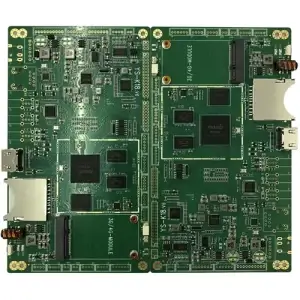
This guide explains what sets industrial control PCB assembly apart, the process decisions that matter most, and how to evaluate a manufacturing partner before you commit a control product to volume production. Whether you are launching a new PLC, retrofitting a motor drive, or scaling an HMI panel through a PCB assembly manufacturer, the standards below are the differences between a board that lasts ten years in the field and one that returns inside the warranty window. Anyone sourcing a control product for industrial deployment should treat these standards as the baseline for evaluating any industrial control PCB assembly partner they are considering.
What Defines Industrial Control PCB Assembly
The phrase covers a deliberately broad family of products — programmable logic controllers, motor drives, human-machine interface panels, industrial sensors, safety relays, distributed control system I/O modules, and gateway boards linking them to supervisory networks. They share one defining trait: ten to fifteen years of reliable operation in environments where temperature swings, noise, vibration, dust, and chemical exposure are normal conditions.
Commercial-grade PCBs are designed for shelf lives of eighteen to thirty-six months, after which rapid obsolescence is expected. Industrial boards run into a different reality. A motor drive installed in a water-treatment plant cannot be casually swapped out every two years — the certification cost, the field-service cost, and the operational disruption make that economically impossible. So industrial control PCB assembly begins with extended-lifecycle design and component sourcing, and that constraint propagates through every downstream process step in the industrial control PCB assembly workflow.
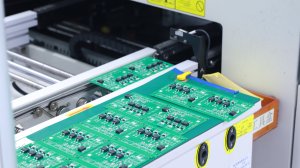
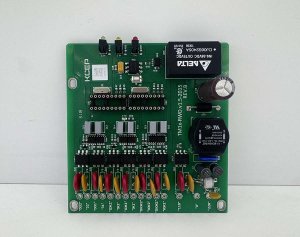
The mix of SMT and through-hole technologies is another signature of industrial control PCB assembly. Connectors, transformers, large capacitors, and high-current terminals remain through-hole parts, while microcontrollers, communication PHYs, and signal conditioning have moved to surface mount. A line configured to run both technologies on the same panel — within thermal profile and inspection windows — is the prerequisite for industrial-grade throughput.

Where Industrial Control Boards Are Used
- Discrete and process manufacturing — PLC racks, robotic cells, conveyor controllers
- Energy and utilities — Substation RTUs, grid-tie inverters, wind turbine controllers, SCADA nodes
- Building automation — HVAC controllers, access control panels, lighting management modules
- Transportation — Railway signaling, port crane controllers, traffic management systems
- Process industries — Chemical dosing pumps, food-grade mixers, pharmaceutical process skids
Each of these environments imposes its own combination of stress factors, but all of them push industrial control PCB assembly toward the same manufacturing philosophy: overbuild deliberately, document rigorously, and qualify the supply chain for the long haul. A one-stop PCBA solution with industrial experience keeps that philosophy consistent from prototype through end-of-life support.
Why Industrial PCBs Demand Stricter Manufacturing Standards
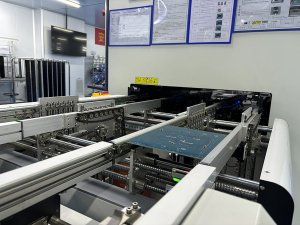
An industrial control board typically operates across -40 °C to +85 °C as a baseline, with many applications demanding -40 °C to +105 °C or wider. That alone disqualifies a wide swath of commercial-grade components. Add surge withstand capability (typically 2 kV to 4 kV on signal lines per IEC 61000-4-5), continuous vibration on machine-mounted equipment, and ten-plus-year production continuity — and the assembly process must be engineered around these constraints from the start.
Three specific stresses set the bar:
- Thermal cycling fatigue. Repeated -40 °C to +85 °C swings drive expansion mismatch between laminate, copper, and component bodies. Solder joints crack, BGAs delaminate, vias barrel-crack. Industrial-grade reflow profiles, copper-balanced stack-ups, and underfill or via-protection measures mitigate these failure modes
- Electromagnetic compatibility. Industrial environments are electrically noisy — variable-frequency drives switch at kilohertz rates, motors throw inductive spikes, welding equipment pumps harmonics back into the mains. PCB layout, grounding topology, shielding, and filter components must be designed in from the start
- Contamination and humidity. Conformal coating, potting, or ruggedized enclosures are routine, not optional. Boards must survive condensation, dust, chemical vapors, and cleaning agents without progressive degradation
A manufacturing line tuned for high-volume consumer smartphones or wearables will struggle with mixed-line reliability expectations if it cannot demonstrate control over reflow profile discipline, AOI/X-ray coverage on heavier components, and conformal-coating application uniformity. Industrial control PCB assembly demands line-side process evidence: reflow profile logs, X-ray sampling records, and traceability data captured per board.
Component Selection for Long Lifecycle Reliability
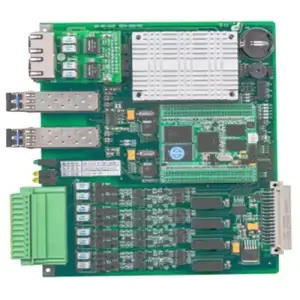
The single longest pole in industrial control PCB assembly planning is component lifecycle. Customers expect — and increasingly contractually demand — that a part number remains in production for ten to fifteen years after a product launch. That obligation lives with the manufacturer, so the BOM must be built around parts with strong staying power. Choosing the wrong part late forces redesigns, requalification testing, and substantial program cost — the situation a deliberate industrial control PCB assembly program is built to avoid.
Industrial-Grade vs Commercial-Grade Components
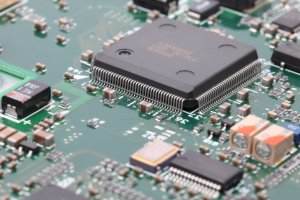
Industrial-grade parts cost more but deliver a step-change in reliability envelope. Look for:
- Extended temperature rating — -40 °C to +85 °C minimum, ideally -40 °C to +105 °C
- Tighter parametric tolerances — Lower drift over time, better PSRR, tighter reference voltage accuracy
- Long-term reliability data — FIT rates documented in the datasheet, not just generic qualification
- Vendor longevity signals — Multi-decade product roadmaps, public life-cycle statements, wide distributor inventory
Obsolescence Management Strategy
Even with careful selection, parts go end-of-life. A proactive program handles this with:
- BOM risk register — Each part flagged with manufacturer, lifecycle window, and last-time-buy estimates
- Approved alternates pre-qualified — Functional equivalents validated through engineering change orders, not field trials
- Safety stock or bonded inventory — Buffer held at the manufacturer for long-lead parts
- Customer disclosure cadence — Quarterly or semi-annual obsolescence reports shared with end customers
This discipline turns turnkey PCB assembly from a transactional purchase into a long-term partnership. Without it, a customer can be left scrambling in year seven of a fifteen-year program.
SMT and Through-Hole Process Considerations
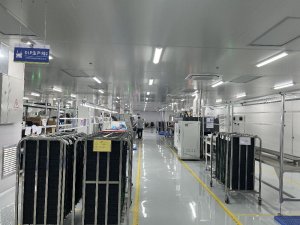
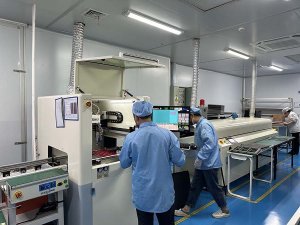
Industrial boards almost always combine SMT and through-hole technology, because connectors, transformers, large capacitors, and high-current terminals remain through-hole parts that cannot easily be surface-mounted. The line has to run mixed technology cleanly. SMT assembly services optimized only for high-density consumer packages will need deliberate adjustment before they can handle industrial control PCB assembly boards reliably.
Reflow Profile Tuning for Industrial Reliability
Standard SAC305 lead-free reflow profiles that work for consumer electronics may not push enough heat into the thermal mass of a heavily copper-balanced industrial board. Profiled ramp rates of 1.0 °C/sec to 2.5 °C/sec, peak temperatures around 240 °C to 245 °C, and TAL (time above liquidus) windows of 60 to 90 seconds are typical starting points. Each new board design warrants a fresh profile verification before production.
Conformal Coating for Harsh Environments
Conformal coating — acrylic, silicone, urethane, or parylene — protects against humidity, contamination, and dendrite growth. Thickness uniformity of 25 to 75 microns is typical, masking precision on connectors and test points must hit tight tolerance, and curing (UV, moisture, or thermal) must match the coating chemistry. Selective robotic coating beats manual brushing on every metric for an industrial product.
Selective Wave Soldering for Through-Hole Reliability
Through-hole components are soldered with mini-wave or selective soldering equipment rather than full-board wave to avoid thermal stress on SMT components and keep flux residue localized. Mini-wave fixtures and nitrogen atmospheres produce cleaner joints with fewer voids. For electronic manufacturing services delivered into industrial markets, selective wave soldering is a baseline capability, not an extra.
Quality Testing and Certification Requirements
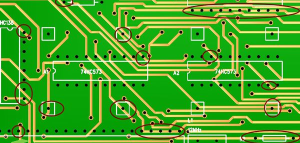
Industrial control products carry safety and EMC marks that turn a circuit into a legally deployable device. The marks vary by region — CE and UKCA in Europe, UL and CSA in North America, CCC in China, KC in Korea — but the testing philosophy is similar. Certification is non-negotiable for industrial control PCB assembly; a failed certification campaign means field recall, regulatory action, and end-customer rejection of the entire product line.
Standards That Shape Industrial Control PCB Assembly Compliance
- UL 508 / UL 60950-1 — Industrial control equipment safety standard for North American market access
- IEC 61131-2 — Functional safety, EMC, and environmental requirements for PLCs specifically
- EN 61000-6-2 / EN 61000-6-4 — Generic EMC immunity and emission standards for industrial environments
- EN 55011 / EN 55022 — Conducted and radiated emission limits
- RoHS 3 (2015/863) and REACH — Substance restrictions in the EU market
Post-Reflow Inspection Stack
Industrial customers expect — and increasingly require — a layered inspection stack rather than a single point-check:
- SPI (Solder Paste Inspection) — Verifies deposit volume and position before reflow; in industrial control PCB assembly, this is the highest-leverage inspection stage because paste defects dominate the Pareto of reflow failures
- 3D AOI (Automated Optical Inspection) — Post-reflow visual check for tombstoning, billboarding, polarity, solder joint presence
- X-ray (AXI) — Inspects hidden joints under BGAs, QFNs, and other no-leads packages for voids, head-in-pillow, and short risks; industrial control PCB assembly programs with BGA-heavy designs cannot omit this stage
- In-Circuit Testing (ICT) or Boundary Scan — Verifies electrical continuity and component values, catches assembly defects invisible to optical inspection
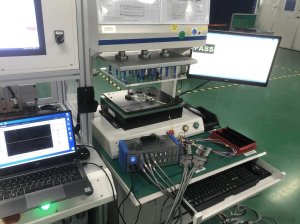
- Functional Testing (FCT) — Powers the board under simulated load conditions, exercising firmware and analog I/O to catch integration defects
When SMT assembly services include all five stages with documented coverage statistics, an industrial buyer can predict field reliability with much higher confidence than with optical inspection alone.
Choosing an Industrial Control PCB Assembly Partner
Most problems found in the field trace back to manufacturing decisions made before the first production run shipped. Picking a partner with the right specializations matters more than picking the cheapest quote. Evaluate candidates against seven factors:
- Industrial vertical track record. Ask for reference projects in PLCs, drives, HMIs, or substation equipment
- Component sourcing depth. Confirm direct relationships with industrial-grade authorized distributors (Arrow, Avnet, WPG, Future) and an anti-counterfeit program
- Long-lifecycle support. Verify obsolescence management, last-time-buy handling, and engineering change order response time
- Certifications on file. Check UL 508, ISO 9001, IATF 16949, and ISO 14001 scopes cover the actual site
- Full inspection stack. SPI, 3D AOI, X-ray, ICT, and FCT must all be available in-house, not outsourced
- Environmental protection capabilities. Conformal coating (selective robotic preferred), potting, and encapsulation should be routine
- Engineering support. DFM, DFA, and reliability test design upstream of production
Request sample builds and witness audits before committing long-term production volume. A partner who welcomes both signals the kind of process maturity your customers will eventually audit on your behalf. Most teams eventually get a free quote from two or three finalists before narrowing to one.
Bringing It All Together
Industrial control PCB assembly is a discipline of overbuilding on purpose. The temperature ratings, the lifecycle commitments, the certification stack, and the inspection depth are not bureaucratic overhead — they are the engineered insurance that a motor drive installed this quarter will still operate in 2041 without an unscheduled plant shutdown. Cutting any one of them shows up not on the production floor but in the field, years later, when warranty cost and customer trust are both at stake.
Selecting components for decade-long availability, mixing SMT and through-hole processes deliberately, protecting assemblies against contamination, and verifying every joint with a layered inspection strategy are the four pillars of industrial-grade manufacturing. A partner that treats those pillars as default behavior — rather than extras to be quoted separately — turns an industrial control PCB assembly program into a manageable, predictable operation.
Contact Keep Best PCBA for professional industrial control PCB assembly services — from prototype through end-of-life — backed by ISO 9001 and IATF 16949 certifications, layered 3D AOI and X-ray inspection, conformal coating and selective wave soldering on the same line, and a documented obsolescence management program. Reach out today to start the conversation about your industrial product program.