
Automotive PCBA Manufacturing: Meeting IATF 16949 and AEC-Q Standards
The automotive industry does not tolerate failure. A defective PCBA in a vehicle can trigger recalls affecting millions of units, cost billions in liability, and irreversibly damage brand trust. The standards that govern automotive electronics — IATF 16949 for quality management, AEC-Q for component qualification, and ISO 26262 for functional safety — are not bureaucratic checkboxes. They are survival mechanisms.
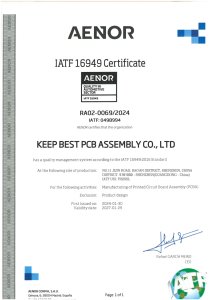
At Keepbest, automotive PCBA manufacturing represents a significant and growing portion of our production. This guide explains what makes automotive electronics different, what certifications and processes are required, and how to qualify a manufacturing partner for your automotive program.
What Makes Automotive PCBA Different?
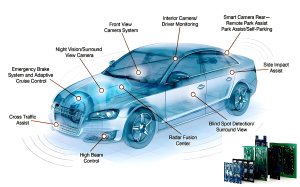
Automotive environments are among the harshest in which electronics must operate.
Temperature Extremes: Under-hood electronics must survive -40°C cold crank and +150°C continuous operation. Cabin electronics experience rapid thermal cycling as vehicles move between sun exposure and shade.
Mechanical Stress: Constant vibration, shock from potholes, and long-term structural fatigue demand robust solder joints and mechanical anchoring.
Electrical Stress: Load dumps, reverse polarity, and electromagnetic interference from ignition systems and electric motors require protection circuits and EMI-compliant layouts.
Longevity: Consumer electronics are designed for three to five years. Automotive electronics are expected to last fifteen years and 300,000 kilometers without degradation.
IATF 16949: The Quality Management Foundation
IATF 16949 is the international standard for quality management systems in the automotive sector. It is built on ISO 9001 but adds automotive-specific requirements.
Key Requirements:
Advanced Product Quality Planning (APQP): A structured method for defining and establishing the steps necessary to ensure customer satisfaction. APQP covers planning, product design, process design, product validation, and feedback.
Production Part Approval Process (PPAP): A standardized submission of documentation including design records, process flow diagrams, control plans, measurement system analysis, dimensional results, material performance, and initial process studies.
Failure Mode and Effects Analysis (FMEA): Both design FMEA and process FMEA are required. Automotive FMEA follows AIAG-VDA methodology with seven-step analysis and action priority instead of risk priority number.
Statistical Process Control (SPC): Key process and product characteristics must be monitored with control charts. Cpk requirements are typically 1.33 minimum for non-critical characteristics and 1.67 for critical safety characteristics.
Change Management: Any change to product, process, or supplier requires formal customer notification and approval under the Supplier Change Request process.
AEC-Q: Component Qualification Standards
The Automotive Electronics Council publishes qualification standards that define the stress tests required to classify components as suitable for automotive use.
| Standard | Scope | Key Tests |
| AEC-Q100 | Integrated circuits | Temperature cycling, high-temperature operating life, ESD, latch-up |
| AEC-Q101 | Discrete semiconductors | Thermal shock, high-temperature reverse bias, humidity bias |
| AEC-Q200 | Passive components | Temperature cycling, board flex, moisture resistance, solderability |

Your manufacturing partner requires AEC-Q qualified components for all automotive builds unless the customer provides explicit documented deviation. Gray-market or unqualified components are rejected at incoming inspection.
Functional Safety and ISO 26262
For safety-critical applications such as braking, steering, and battery management, ISO 26262 defines requirements for functional safety throughout the product lifecycle.
Automotive Safety Integrity Levels (ASIL): From ASIL A (lowest) to ASIL D (highest). Higher ASIL levels require more rigorous analysis, testing, and documentation.
The EMS provider Role: As a manufacturing partner, Our assembly team supports functional safety through controlled processes, full traceability, change control, and proven process capability. We do not design safety architectures, but we ensure that the manufacturing process does not introduce faults that compromise the designer’s safety case.
Automotive PCBA Manufacturing Process at Keepbest
Incoming Material Control: All components verified for AEC-Q qualification, lot traceability, moisture sensitivity level, and packaging integrity. XRF screening for RoHS compliance.
Process Controls: Nitrogen reflow for all automotive assemblies to minimize voids. 100% AOI and X-ray inspection. ICT and FCT with traceable test data.
Traceability: Every component lot number linked to every board serial number. Full forward and backward traceability for recall management.
Environmental Testing: In-house thermal cycling and coordinated third-party testing for vibration, mechanical shock, and ESD per customer specifications.
Frequently Asked Questions
Q: Can a non-IATF 16949 certified manufacturer produce automotive PCBAs?
Technically yes for aftermarket or non-safety applications, but no Tier 1 or OEM supplier will approve an uncertified partner for production. IATF 16949 certification is the price of entry.
Q: What PPAP level does A qualified PCBA supplier support?
We support PPAP Levels 1 through 5, with Level 3 being the most common for new product introductions. Level 5 includes on-site validation of all documentation and records.
Q: How does The production partner handle component obsolescence in long automotive programs?
We monitor component lifecycles through our MES and distributor partnerships. End-of-life notifications trigger proactive customer communication with last-time-buy recommendations and qualified alternates.
Q: What is the typical lead time for automotive PCBA prototypes?
Four to six weeks including DFM review, component procurement, first-article build, and PPAP documentation. Expedited timelines are possible for mature designs with clean BOMs.
Q: Does Your PCBA partner support electric vehicle battery management systems?
Yes. We assemble BMS control boards, cell monitoring units, and high-voltage isolation boards with the process controls and traceability required for EV applications.
Evaluating a manufacturing partner for your automotive program? Request our IATF 16949 certificate, automotive customer references, and sample PPAP submission. The Keepbest automotive team is ready to support your qualification audit.