
AEC-Q100/Q200 Requirements for Automotive Electronics in PCB Assembly
Automotive electronics have far higher reliability requirements than consumer electronics; AEC-Q100 (integrated circuits) and AEC-Q200 (passive components) are industry-recognized standards. This article analyzes the specific requirements for automotive electronics PCB assembly.

Overview of the AEC Standards System
The AEC (Automotive Electronics Council) has established a series of component reliability standards.
Key standards include: AEC-Q100 (ICs), AEC-Q101 (discrete semiconductors), AEC-Q102 (optoelectronic devices), AEC-Q103 (sensors), AEC-Q104 (multi-chip modules), and AEC-Q200 (passive components).
Core Requirements: Temperature grades (Grade 0: -40 to 150°C, Grade 1: -40 to 125°C) and a series of accelerated life tests.
Temperature Grades and Material Selection
Automotive-grade products must operate under extreme temperatures.
PCB Materials: High Tg (>170°C), low CTE (coefficient of thermal expansion), and high Td (decomposition temperature).
Solder Paste Selection: High-temperature solder paste (e.g., Sn95Sb5, melting point 235–240°C) to prevent secondary melting during high-temperature reflow.
Component Certification: All components must pass the corresponding AEC-Q certification and provide PPAP (Production Part Approval Process) documentation.

IATF 16949 Quality Management System
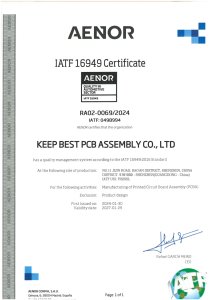
Automotive electronics manufacturing facilities must be certified to IATF 16949.
Core Elements: APQP (Advanced Product Quality Planning), PPAP, FMEA (Failure Mode and Effects Analysis), MSA (Measurement System Analysis), and SPC (Statistical Process Control).
Special Requirements: Change management (strict approval processes), traceability (each product batch must be traceable to specific lot numbers and parameters), and a zero-defect target.
Special Process Controls
The process windows for automotive electronics are narrower.
Solder Paste Printing: 100% SPI inspection, volume tolerance of ±10% (typically ±25%).
Surface Mount Assembly: Critical components (such as airbag chips) require visual documentation of placement position and orientation.
Reflow: Actual temperature profiles measured every 4 hours; nitrogen protection is mandatory.
Testing: 100% ICT + 100% FCT + aging test (typically 168 hours) .
Zero Kilometer Defect
The automotive industry has zero tolerance for defects at the time of shipment.
Control Measures: Poka-Yoke error-proofing design, comprehensive automated inspection, and Supplier Quality Gate.
Consequences: Defective products may lead to recalls, with costs reaching hundreds of millions of dollars.

Traceability Requirements
Automotive electronics require full lifecycle traceability.
Traceability Scope: PCB board batches, solder paste batches, all component batches, stencil numbers, reflow oven temperature curve IDs, and test data.
Retention Period: Typically 15 years (matching the vehicle’s lifespan).
Automotive electronics PCB assembly is a high-end manufacturing sector. Selecting a factory certified to IATF 16949, with access to AEC-Q component procurement channels and a comprehensive traceability system, is the foundation for entering the automotive supply chain.

Frequently Asked Questions (FAQ)
Q1: What is the difference between AEC-Q100 and industrial-grade components?
A: The main differences lie in the temperature range and the rigor of testing. AEC-Q100 Grade 1 requires a temperature range of -40 to 125°C, while industrial-grade components typically operate from -40 to 85°C. AEC-Q100 components must also pass additional tests such as HTOL (High-Temperature Operating Life), ESD, and latch-up. Automotive-grade components are typically 20–50% more expensive.
Q2: Can consumer-grade components be used in automotive electronics?
A: Strictly speaking, no. Automotive OEMs and Tier 1 suppliers require all components to be AEC-Q certified and to provide PPAP documentation. Using non-certified components will result in failure to pass customer audits and poses significant quality risks. In very rare cases, non-standard components may be evaluated through special certification processes (such as PPAP Level 5).
Q3: What is the difference between IATF 16949 and ISO 9001?
A: IATF 16949 builds upon ISO 9001 by adding specific requirements for the automotive industry: APQP, PPAP, FMEA, MSA, SPC, and embedded software management (if applicable). IATF 16949-certified facilities must undergo annual surveillance audits, and certificates are issued by IATF-authorized bodies.
Q4: Why is 100% testing required for automotive electronics?
A: Automotive safety regulations (such as ISO 26262 Functional Safety) require a defect rate of <1 ppm for critical systems (braking, steering, airbags). 100% ICT and FCT are essential for achieving this goal. Consumer electronics typically undergo only sampling inspections (AQL 0.65 or 1.0).
Q5: How long must traceability data for automotive electronics be retained?
A: Typically 15 years, in line with the vehicle’s design life and regulatory requirements. Some critical safety systems (such as airbag controllers) require retention for over 20 years. This means that factories must establish a long-term data archiving system and ensure data readability (taking into account technological advancements).