
The automotive industry places demands on PCB assembly that exceed those of virtually every other commercial electronics sector. A navigation system that fails is an inconvenience. An engine control unit or brake system module that fails is a safety hazard. This reality drives automotive electronics manufacturing toward the highest reliability standards in the industry.
As vehicles evolve into sophisticated computing platforms with dozens of electronic control units, advanced driver assistance systems, and electric powertrain electronics, the requirements for PCB assembly quality and reliability continue to escalate. This article examines the standards, processes, and best practices specific to automotive electronics manufacturing.
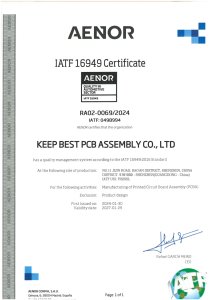
IATF 16949: The Automotive Quality Standard
IATF 16949 is the global quality management standard for automotive production and service parts. It builds on ISO 9001 with additional requirements specific to the automotive supply chain, including defect prevention, reduction of variation and waste, and continuous improvement methodologies.
For PCB assembly operations, IATF 16949 certification requires more than documentation. It demands demonstrated process capability through statistical methods, formalized risk assessment using failure mode and effects analysis for every manufacturing process, documented contingency plans for equipment failures and supply disruptions, and rigorous management of sub-tier suppliers including component distributors and bare board fabricators.
The standard also requires specific quality metrics including customer-reported defect rates, internal scrap and rework rates, on-time delivery performance, and premium freight occurrences. These metrics must be tracked, reported, and trended, with corrective action plans required when targets are missed. For automotive customers, this transparency into supplier quality performance is as important as certification status.
Production Part Approval Process
PPAP is a standardized process for validating that a supplier’s production process consistently produces parts meeting all engineering specifications. For PCB assembly, a typical PPAP submission includes dimensional results confirming board outline and thickness, material certifications for laminate and solder mask, solderability test results, first-article inspection reports with full dimensional verification, process capability studies demonstrating stable and capable processes, and a production sample run demonstrating sustained quality.
The PPAP process is resource-intensive for both supplier and customer, but it provides confidence that production parts will match the quality of samples used for design validation. Rushing through or shortcutting PPAP creates risks that inevitably surface as production quality issues.
AEC-Q Component Qualification
Components used in automotive electronics face qualification requirements defined by the Automotive Electronics Council. AEC-Q100 covers integrated circuits, AEC-Q101 addresses discrete semiconductors, and AEC-Q200 applies to passive components. These standards define stress test requirements including temperature cycling, high-temperature operating life, and biased humidity testing that far exceed typical commercial component qualification.
Using AEC-Q qualified components is a baseline requirement for most automotive applications. However, component qualification alone does not guarantee assembly reliability. The assembly process itself must be validated for use with automotive-qualified components, as even the most robust IC can be damaged by improper handling during assembly.
Component change management takes on added significance in automotive applications. Unlike commercial products where a functionally equivalent component substitution requires minimal documentation, automotive customers typically require formal notification and re-approval for any component change. This includes changes to the component itself, the component manufacturer’s process, or the manufacturing location. PCB assembly partners serving automotive customers must have robust systems for tracking and communicating component changes.
Thermal Management in Automotive Environments
Automotive electronics face thermal conditions that most commercial products never encounter. An under-hood ECU may see ambient temperatures ranging from negative 40 degrees Celsius on a winter morning to over 125 degrees Celsius after heat soak on a summer day. The PCB assembly must survive not just these extremes but the repeated thermal cycling between them over years of vehicle operation.
Thermal management strategies for automotive PCBs include the use of high-temperature laminate materials with glass transition temperatures above 170 degrees Celsius, heavy copper layers for power distribution and heat spreading in motor control and power conversion applications, thermal vias under heat-generating components to conduct heat to copper planes or dedicated heatsinks, and conformal coating to protect against condensation that can form during rapid temperature changes.
Solder joint reliability under thermal cycling is a critical concern. The mismatch in coefficient of thermal expansion between component packages, solder, and the PCB substrate creates mechanical stress with every temperature change. Over thousands of cycles, this stress can cause solder joint fatigue and eventual failure. Proper pad design, component selection, and underfill for large BGA packages all contribute to solder joint longevity in automotive applications.
Functional Safety and ISO 26262
For safety-critical automotive systems such as braking, steering, and advanced driver assistance, ISO 26262 functional safety requirements add another layer of manufacturing discipline. The standard defines Automotive Safety Integrity Levels from A to D, with ASIL D representing the highest safety criticality where a system failure could cause life-threatening injury.
Manufacturing for ASIL-compliant systems requires additional controls including 100 percent automated inspection with data retention for every assembly, process parameter monitoring with automatic shutdown if parameters exceed validated limits, and traceability linking every component on every board to its specific production lot and test results.
Selecting a PCB assembly manufacturer for automotive applications requires thorough evaluation of quality certifications, process capability data, and specific experience with automotive programs. The cheapest option almost never proves cheapest when total cost of quality is considered. A partner with demonstrated automotive quality systems provides the confidence that your products will perform reliably for the vehicle’s entire service life.