MES (Manufacturing Execution System) serves as the bridge between ERP and the production floor, enabling end-to-end digital management of the PCB assembly process. This article analyzes the core functions and implementation value of MES.
MES Positioning and Functions
MES is positioned between the planning layer (ERP) and the control layer (equipment), collecting and processing production data in real time.
Core Functions: Production scheduling, work order management, material traceability, quality management, equipment monitoring, and data analysis.
Difference from ERP: ERP manages resources and planning, while MES manages execution and the shop floor.
Work Order and Production Scheduling Management
MES breaks down ERP production plans into executable work orders.
Management Scope: Work order issuance, priority adjustments, production line allocation, and real-time progress tracking.
Value: Reduces paper-based documentation, shortens changeover time, and enables rapid response to urgent order insertions.
Material Traceability and Error Prevention
The electronics manufacturing industry involves a wide variety of materials and complex batch management.
Traceability Capabilities: Linking material batches to PCB serial numbers, managing solder paste/flux opening times, and recording the use of substitute materials.
Error-Proofing Mechanisms: Material loading verification (scanning tray barcodes against the BOM), station-level error-proofing, and automatic locking of expired materials.
Quality Data Collection
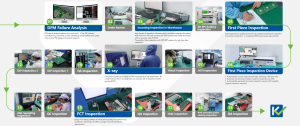
The MES integrates with inspection equipment to enable automatic collection of quality data.
Data Collected: SPI/AOI/X-ray inspection results, ICT/FCT test data, and repair records.
Benefits: Real-time SPC monitoring, automatic alerts for anomalies, and reduced manual data entry errors.
Equipment Integration and Monitoring
MES communicates with SMT equipment (typically via SECS/GEM or OPC protocols).
Monitoring Scope: Equipment status (running/standby/failure), key parameters (temperature, pressure, speed), and OEE (Overall Equipment Effectiveness) calculations.
Alert Functions: Automatic alerts for out-of-specification parameters and predictive maintenance reminders.
Data Analysis and Continuous Improvement
Big data accumulated by MES supports optimized decision-making.
Analysis Focus: Yield trends, defect distribution, equipment OEE, material waste, and labor efficiency.
Improvement Tools: Pareto analysis, fishbone diagrams, and Six Sigma projects.
MES is central to the digital transformation of PCB assembly factories. Implementing MES requires business process reengineering, equipment interface development, and staff training, but the long-term returns are significant.
Frequently Asked Questions (FAQ)
Q1: What is the difference between MES and ERP?
A: ERP manages enterprise resources (finance, procurement, sales, inventory) and is a planning-level system. MES manages production execution (work orders, equipment, quality, traceability) and is an execution-level system. The two are integrated via interfaces: ERP issues plans, and MES reports execution results.
Q2: How long does it take to implement MES?
A: Typically 6–18 months, depending on the factory’s size and complexity. Phases include: requirements analysis (1–2 months), system configuration (2–4 months), equipment interface development (2–6 months), data migration and trial operation (2–4 months), and go-live optimization (ongoing). Small and medium-sized factories can opt for cloud-based MES to shorten the implementation cycle.
Q3: Can MES prevent the misuse of materials?
A: Yes. Through barcode/RFID scanning, MES automatically compares the BOM during material loading. If it detects errors in part numbers, batches, or workstation assignments, it locks the equipment and triggers an alarm. This is one of MES’s core error-proofing functions, capable of reducing the material misuse rate to near zero.
Q4: How is data security ensured in MES?
A: Measures include: on-premises servers with cloud backups, role-based access control, operation log auditing, and network security protections (firewalls, VPN). Factories handling customer design data must also comply with ITAR or customer-specific data security requirements.
Q5: Is it necessary for small factories to implement MES?
A: It depends on the scale. For factories with fewer than five production lines, the return on investment for MES is relatively long; it is advisable to start with core modules (material traceability, quality management). For factories with 10 or more production lines or those manufacturing highly complex products (such as automotive electronics), MES is virtually essential. Cloud-based MES lowers the entry barrier for small factories.