
Medical PCBA Manufacturing: ISO 13485, Biocompatibility, and Reliability Requirements
Medical devices are not consumer electronics with a longer warranty. They are systems where a single solder joint failure can endanger a patient’s life, trigger a regulatory recall, and expose manufacturers to criminal liability. The PCBA at the heart of a medical device must meet standards that go far beyond typical industrial or commercial requirements. At Keepbest, medical PCBA manufacturing is governed by a quality system built on ISO 13485. Traceability protocols track every component to every patient. Process controls eliminate variability before it becomes a defect.
This guide explains what makes medical PCBA manufacturing different, what certifications are mandatory, what design and process requirements apply, and how to qualify a manufacturing partner for your medical program.
What Makes Medical PCBA Different?
Medical electronics operate under constraints that no other product category faces simultaneously.
Patient Safety: A failed insulin pump, a corrupted ECG signal, or a defective defibrillator charge circuit can cause injury or death. Medical PCBAs are classified by risk — Class I (low risk), Class II (moderate risk), and Class III (high risk, life-supporting) — with manufacturing rigor increasing at each level.
Regulatory Oversight: Medical devices sold in the United States require FDA clearance (510k) or approval (PMA). The European Union requires CE marking under the Medical Device Regulation (MDR). Each jurisdiction audits the manufacturer’s quality system and can suspend market access for non-compliance.
Long Product Lifecycles: Medical devices often remain in production for ten to fifteen years. This requires robust component lifecycle management, obsolescence monitoring, and last-time-buy planning that consumer electronics manufacturers rarely encounter.
Traceability: Every component on every board must be traceable by lot number, date code, and manufacturer. If a capacitor vendor later discovers a reliability defect, the manufacturer must identify every board containing that lot and every patient potentially affected.
Biocompatibility: For devices with patient contact, the materials used in the PCBA must meet biocompatibility standards. This includes solder, flux, coatings, and adhesives. Materials must comply with ISO 10993 to ensure they do not trigger adverse biological reactions.

ISO 13485: The Medical Quality Management Standard
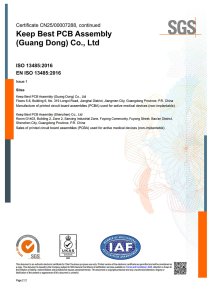
ISO 13485 is the internationally recognized standard for quality management systems in the medical device industry. It shares DNA with ISO 9001 but adds requirements specific to medical device design, production, and post-market surveillance.
Key Requirements:
Risk Management: ISO 14971 risk management must be integrated throughout the product lifecycle. Manufacturing risks — including process drift, contamination, and human error — are identified, evaluated, and controlled with the same rigor as design risks.
Design Controls: Design inputs, outputs, verification, and validation must be documented and traceable. Changes to the design after release require formal review, impact assessment, and regulatory notification if the change affects safety or performance.
Process Validation: Processes where the output cannot be fully verified by subsequent inspection must be validated. These include sterilization, sealing, and certain soldering operations. Validation requires documented evidence of capability.
Traceability: Complete forward and backward traceability is required. Every component lot must be linked to every finished device serial number. This enables targeted recalls without scrapping entire production lots.
Sterile Device Considerations: For devices requiring terminal sterilization, the manufacturing process must account for the effects of gamma, e-beam, ethylene oxide, or steam sterilization on materials and solder joints.
IPC Standards for Medical PCBAs
The IPC standards define workmanship and performance requirements for electronic assemblies. Medical devices typically require Class 3 — the highest reliability classification.
| Standard | Scope | Medical Relevance |
| IPC-A-610 | Acceptability of electronic assemblies | Class 3 workmanship for high-reliability medical devices |
| IPC-J-STD-001 | Requirements for soldered electrical and electronic assemblies | Class 3 process control and materials handling |
| IPC-1752A | Materials declaration management | RoHS/REACH data for biocompatibility assessment |
| IPC-TM-650 | Test methods manual | Ionic contamination testing for patient-contact devices |
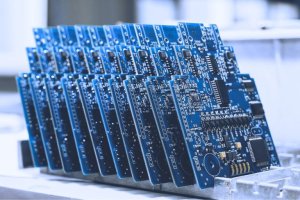
Your manufacturing partner trains all production and quality personnel to IPC-A-610 Class 3 criteria. Incoming inspection, in-process checks, and final acceptance all reference Class 3 workmanship standards.
Component Selection and Biocompatibility
Component selection for medical devices extends beyond electrical performance to include material safety and long-term reliability.
Biocompatibility Assessment: For devices with patient contact, materials must be evaluated per ISO 10993. This includes solder alloys, flux residues, conformal coatings, adhesives, and substrate materials. Lead-free SAC305 solder is generally preferred for biocompatibility, though some implantable devices may require specialized alloys.
Moisture Sensitivity: Medical devices often require hermetic sealing or conformal coating. Components with high moisture sensitivity levels (MSL 4 and above) require controlled handling, baking before reflow, and vacuum sealing in moisture-barrier bags with desiccant and humidity indicators.
Obsolescence Management: With production lifecycles measured in decades, component obsolescence is a critical risk. The EMS provider monitors component lifecycle status through distributor partnerships and notifies customers 18 to 24 months before last-time buy. Proactive alternate qualification prevents forced redesigns mid-lifecycle.
Manufacturing Process Controls for Medical PCBA
Cleanroom Environment: Assembly of implantable and critical-care devices may require ISO 8 (Class 100,000) or better cleanroom conditions to control particulate contamination.
Ion Contamination Control: For high-impedance medical circuits, ionic contamination from flux residues can create leakage currents that corrupt sensitive analog signals. Our assembly team performs ion chromatography per IPC-TM-650 Method 2.3.28 to verify cleanliness.
Nitrogen Reflow: All medical-grade assemblies are processed in nitrogen atmosphere to minimize solder voids, improve wetting, and enhance long-term reliability under thermal cycling.
100% Inspection Stack: SPI, post-placement AOI, post-reflow AOI, X-ray for hidden joints, ICT, and FCT are all standard for medical devices. Inspection data is retained for the product lifecycle plus two years.

Documentation and Regulatory Support
Device Master Record (DMR): The complete compilation of records containing the procedures and specifications for a finished device. A qualified PCBA supplier contributes the manufacturing process portion of the DMR, including process flows, control plans, and inspection records.
Device History Record (DHR): The compilation of records containing the production history of a finished device. The production partner maintains DHR data including component lot numbers, test results, calibration records, and operator signatures.
510k and PMA Support: For FDA submissions, Keepbest provides process validation data, biocompatibility assessments, and manufacturing facility information for inclusion in regulatory filings.
Frequently Asked Questions
Q: Does every medical device require Class 3 workmanship?
Not necessarily. Non-critical devices such as hospital-grade power strips or bed position controllers may qualify for Class 2. Life-supporting and implantable devices always require Class 3. Your PCBA partner evaluates each design’s intended use and regulatory classification to determine the appropriate workmanship standard.
Q: Can The supplier support FDA 510k submissions?
Yes. We provide process validation documentation, biocompatibility assessments, facility registration information, and quality system documentation to support our customers’ 510k submissions. We do not prepare submissions directly but serve as a qualified manufacturing partner.
Q: How long are manufacturing records retained for medical devices?
Our engineering team retains production and test records for the product lifecycle plus two years, or longer if specified by the customer’s quality agreement. This supports regulatory audits, field failure investigations, and potential recalls.
Q: What is the typical lead time for medical PCBA prototypes?
Four to six weeks including DFM review, component procurement with biocompatibility verification, first-article build, and full inspection documentation. Expedited timelines are possible for designs with clean BOMs and in-stock components.
Q: Does The manufacturing team assemble implantable devices?
We assemble PCBAs for implantable device manufacturers, including pacemakers, neurostimulators, and drug delivery pumps. These builds require specialized cleanroom handling, biocompatible materials, and hermetic sealing coordination with our customers’ final assembly processes.
Q: What is the difference between ISO 13485 and FDA QSR?
ISO 13485 is the international standard. FDA QSR (21 CFR Part 820) is the U.S. regulation. They are substantially aligned, though FDA places greater emphasis on design history files and corrective action documentation. A trusted assembly provider’s quality system satisfies both frameworks.
Evaluating a manufacturing partner for your medical device? Request our ISO 13485 certificate, IPC-A-610 Class 3 training records, and sample DHR documentation. The Keepbest medical team is ready to support your qualification audit and regulatory submission.