
The IPC standards are the universal language of electronics manufacturing. When a designer specifies IPC-A-610 Class 3, and an assembler confirms compliance, both parties share a common reference. They use a detailed, photographically illustrated set of acceptance criteria. These criteria eliminate ambiguity about what constitutes an acceptable solder joint, an acceptable component placement, or an acceptable board condition. At Keep best, IPC standards govern every inspection decision on our production floor. Understanding these classifications helps you specify the right quality level for your product without overpaying for unnecessary rigor or under-specifying critical applications.
This guide explains the three IPC workmanship classes, what each requires, when to specify each, and how Your manufacturing partner implements IPC standards across our quality system.
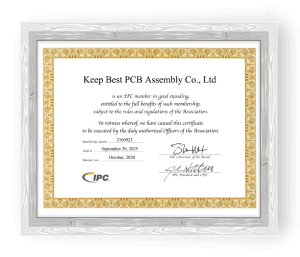
What Are IPC Standards?
IPC — originally the Institute for Printed Circuits, now IPC — is a global trade association that publishes standards for the electronics industry. The standards most relevant to PCBA manufacturing are:
| Standard | Title | Purpose |
| IPC-A-610 | Acceptability of Electronic Assemblies | Visual workmanship criteria for solder joints, components, and board conditions |
| IPC-J-STD-001 | Requirements for Soldered Electrical and Electronic Assemblies | Process requirements for materials, methods, and verification |
| IPC-1752A | Materials Declaration Management | Data exchange for environmental compliance (RoHS/REACH) |
| IPC-TM-650 | Test Methods Manual | Standardized test procedures for PCB and assembly verification |
| IPC-2221 | Generic Standard on Printed Board Design | Design rules and requirements for PCB layout |
The Three Workmanship Classes
IPC-A-610 defines three classes of workmanship based on the end-use environment and reliability requirements.
Class 1 — General Electronic Products
Class 1 applies to products where the primary requirement is function of the completed assembly. Continuity of production and low unit cost are prioritized over extended life or performance under stress. Cosmetic imperfections are acceptable provided they do not affect electrical function.
Typical Applications: Consumer electronics, toys, office equipment, non-critical household appliances.
Acceptance Criteria: Solder joints must be continuous and wet the surfaces being joined. Minor voids, surface roughness, and cosmetic irregularities are acceptable. Component placement must be correct but need not be precisely centered.
Class 2 — Dedicated Service Electronic Products
Class 2 applies to products where continued performance and extended life are required, and for which uninterrupted service is desired but not critical. Most industrial, commercial, and communications equipment falls into this category.
Typical Applications: Industrial controls, test equipment, networking hardware, medical devices (non-life-support), automotive (non-safety-critical).
Acceptance Criteria: Solder joints must exhibit good wetting with smooth, concave fillets. Voids are limited to 25% of joint area. Component placement must be accurate with minimal skew. Cleanliness requirements are more stringent than Class 1.
Class 3 — High-Performance / Harsh Environment Electronic Products
Class 3 applies to products where continued high performance or performance-on-demand is critical, equipment downtime cannot be tolerated, and the operating environment is exceptionally harsh or life-supporting. Failure could result in loss of life or critical system damage.
Typical Applications: Medical life-support devices, aerospace and defense systems, automotive safety-critical electronics, telecommunications infrastructure, nuclear controls.
Acceptance Criteria: Solder joints must be virtually perfect — smooth, bright, fully wetted fillets with no visible voids, cracks, or surface irregularities. Component placement must be precise. Ionic contamination must be minimized. The entire assembly must withstand extended environmental stress without degradation.
Class Selection Decision Matrix
| Application Factor | Class 1 | Class 2 | Class 3 |
| Failure consequence | Inconvenience | Financial loss, downtime | Injury, death, mission failure |
| Environmental stress | Benign indoor | Moderate industrial | Harsh, extreme, or life-support |
| Required lifespan | 1-3 years | 3-10 years | 10+ years |
| Rework allowed | Yes, with inspection | Yes, with enhanced inspection | Minimized; prefer scrap |
| Inspection intensity | Basic AOI | AOI + X-ray + ICT | Full stack + environmental screening |
| Cost premium | Baseline | +10-20% | +30-50% |
The EMS provider IPC Implementation
Training: All production operators, inspectors, and quality engineers are trained to IPC-A-610 and IPC-J-STD-001 standards. Training is refreshed annually and documented in personnel records.
Inspection Protocols: Class 1 products receive standard AOI and visual inspection. Class 2 products add X-ray for hidden joints and ICT for electrical verification. Class 3 products receive the full inspection stack including SPI, AOI, X-ray, ICT, FCT, and ionic contamination testing.
Documentation: Inspection results are documented per IPC requirements. For Class 3 and regulated industries, certificates of conformance reference the specific IPC standard and class level.
Continuous Improvement: Defect data is analyzed against IPC criteria to identify process improvement opportunities. When defect rates approach IPC limits, preventive actions are triggered before non-conformance occurs.
Frequently Asked Questions
Q: Can I specify different classes for different parts of the same board?
Generally no. IPC-A-610 applies to the entire assembly. However, you can specify enhanced inspection or test requirements for critical circuits while maintaining the base class for the remainder. Keepbest can structure hybrid quality plans to meet your reliability needs.
Q: Does Class 3 guarantee zero defects?
No standard guarantees zero defects. Class 3 sets the most stringent acceptance criteria, but statistical variation means some defects may still escape. The layered inspection approach minimizes escape rate to industry-best levels.
Q: How much more expensive is Class 3 compared to Class 2?
Typically 30-50% more due to enhanced inspection, tighter process controls, reduced rework latitude, and additional documentation. For life-critical applications, this premium is insignificant compared to the cost of failure.
Q: Can Our assembly team certify to IPC standards?
A qualified PCBA supplier trains personnel to IPC standards and inspects to IPC criteria. Formal IPC certification of individual operators is available upon customer request. Our quality system is audited externally for compliance.
Q: What is the difference between IPC-A-610 and IPC-J-STD-001?
IPC-A-610 defines visual acceptance criteria — what a good joint looks like. IPC-J-STD-001 defines process requirements — how to create a good joint through materials, methods, and verification. Both are necessary for a complete quality system.
Q: Should my prototype be Class 3 even if production is Class 2?
Prototypes should be built to the same standard as production to validate process capability. Building prototypes to a lower standard and then upgrading for production creates validation gaps that can surprise you at the worst moment.
Unsure which IPC class your product requires? Send your application requirements to the Keepbest quality engineering team. We will recommend the appropriate workmanship class, inspection protocol, and documentation package matched to your reliability goals and regulatory environment.