
From Prototype to Mass Production: The NPI Process for PCBA
A brilliant PCB design is worthless if pcba cannot be manufactured reliably at scale. The bridge between a working prototype and a profitable product is the New Product Introduction (NPI) process. This structured sequence of engineering validation, process development, and risk mitigation ensures your design survives contact with the factory floor. At Keep best, we guide customers through NPI every week. This guide explains what happens at each stage, what deliverables you should expect, and how to compress your time-to-market without compromising quality.
What Is NPI and Why Does It Matter?
New Product Introduction is the disciplined transition of a design from prototype validation to repeatable mass production. It is not merely “making more boards.” It is the systematic elimination of unknowns: unknown component behaviors, unknown process sensitivities, unknown test coverage gaps, and unknown supply chain risks.
The cost of skipping or rushing NPI is measured in field failures, production line stops, emergency engineering changes, and damaged customer relationships. A proper NPI investment of two to four weeks at the front end prevents months of chaos downstream.
Stage 1: Design for Manufacturability Review
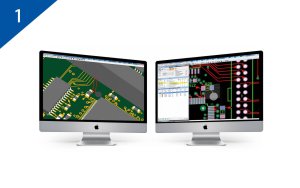
Before any prototype is built, Your manufacturing partner engineering reviews the complete design package for manufacturability risks.
What We Review: Gerber files, BOM with manufacturer part numbers, centroid file, assembly drawings, test specifications, and quality standards.
Common Flags: Insufficient component spacing, missing fiducials, tombstone-prone pad geometries, inadequate test point coverage for ICT, high aspect ratio vias, and stencil aperture ratios below 0.66.
Deliverable: DFM report returned within 48 hours with prioritized recommendations. Critical issues must be resolved before stencil fabrication. Advisory issues are tracked for first-article validation.
Stage 2: Component Procurement and BOM Scrub
The BOM is the DNA of your product. Errors here propagate through every subsequent stage.
Actions: Cross-reference every part number against authorized distributor inventory. Identify obsolete, end-of-life, or allocation-constrained parts. Validate alternates for form, fit, and function. Confirm moisture sensitivity levels and shelf-life requirements.
Deliverable: Scrubbed BOM with procurement status, alternates, and long-lead-time items flagged. This directly feeds the master production schedule.
Stage 3: Process Development and First Article Build
The first articles are not prototypes. They are process validation vehicles. Every parameter that will govern mass production is established during this build.
Stencil Fabrication: Laser-cut stainless steel stencil, typically 100 to 150 microns thick, with aperture geometries optimized for each pad. Area ratios and home-plate shapes are calculated for clean paste release.
Reflow Profile Development: Thermocouples are attached to critical components. The board is profiled through the reflow oven to validate preheat, soak, peak, and cooling phases. Profile data is logged and stored with the lot record.
Placement Program Generation: The centroid file is imported into the placement machine. Component orientations are verified against assembly drawings. Polarity markings are confirmed.
First Article Inspection: The first completed boards undergo 100% inspection including SPI, AOI, X-ray for hidden joints, ICT, and functional test. Results are compared against design expectations.
Deliverable: First Article Inspection Report with dimensional data, electrical measurements, solder joint images, and disposition.
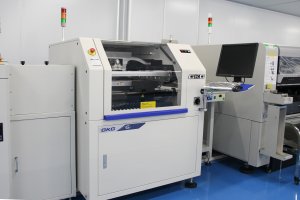
Stage 4: Process Qualification and Capability Study
Once the first articles pass, the process must be proven capable of consistent repetition.
Statistical Process Control Setup: Key process parameters including paste volume, placement accuracy, reflow peak temperature, and ICT yield are charted. Control limits are established.
Gage Repeatability and Reproducibility: Measurement systems for critical dimensions are validated to ensure inspector and equipment variation are within acceptable limits.
Process Failure Mode and Effects Analysis: The cross-functional team identifies potential failure modes, assigns risk priority numbers, and implements preventive controls.
Deliverable: Process Capability Study showing Cpk values for critical parameters, and PFMEA document with closed action items.
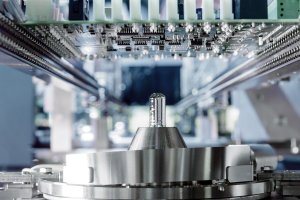
Stage 5: Pilot Production Run
The pilot run validates the process at small scale before capital and inventory are committed to full production.
Typical Volume: 50 to 500 units depending on product complexity and customer requirements.
Purpose: Confirm that the process developed on first articles scales to a production line with operators, material handlers, and quality technicians. Identify training gaps, fixture limitations, and material feeding issues.
Yield Monitoring: Real-time yield tracking with automatic alarm thresholds. Any drop below target triggers immediate containment and root cause analysis.
Deliverable: Pilot Run Report with yield data, defect Pareto, corrective actions, and readiness assessment for mass production.
Stage 6: Production Release and Continuous Monitoring
With pilot run success, the product is released to mass production. But NPI does not end at release.
Change Control: Engineering change orders are managed through a formal process. Impact assessments cover inventory, tooling, test fixtures, and customer notification.
Supplier Performance Monitoring: Component quality, delivery performance, and counterfeit risk are tracked monthly.
Field Feedback Loop: Customer returns and field failures are analyzed with 8D methodology. Findings feed back into design rules and process controls.
Deliverable: Production Part Approval Process package for automotive and regulated industries. Annual process audits and requalification as required.
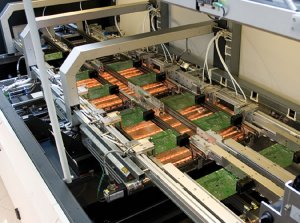
NPI Timeline: What to Expect
| Stage | Duration | Parallel Activities |
| DFM review | 2–3 days | Component procurement initiation |
| BOM scrub and sourcing | 1–2 weeks | Long-lead alternates evaluation |
| First article build | 1 week | Reflow profile, placement program |
| Process qualification | 1 week | SPC setup, gage R&R, PFMEA |
| Pilot production | 1–2 weeks | Yield monitoring, operator training |
| Production release | 1 day | PPAP submission, change control |
Typical total NPI duration: 4–6 weeks from complete RFQ to mass production release.
Expedited NPI: 2–3 weeks possible when BOM is clean, components are in stock, and design requires no revisions.
Frequently Asked Questions
Q: What is the difference between a prototype and a first article?
A prototype proves the design concept electrically. A first article proves the manufacturing process can repeatably produce conforming units. First articles are built with production intent processes, not quick-turn shortcuts.
Q: How many first articles should I request?
Five to ten units is standard for simple boards. Complex boards with hidden joints, high layer counts, or stringent test requirements may warrant twenty units to provide statistical confidence.
Q: What happens if first articles fail inspection?
Failures are categorized as design-related, process-related, or component-related. Design issues are escalated to the customer for Gerber revision. Process issues are resolved internally with revised parameters. Component issues trigger alternate sourcing or vendor corrective action.
Q: Do I need NPI for every product revision?
Minor revisions such as silkscreen changes or passive value updates may qualify for abbreviated requalification. Major revisions affecting layer stack-up, component pitch, or test coverage require full NPI.
Q: What is PPAP and when is it required?
Production Part Approval Process is a structured submission of documentation proving the process can consistently meet requirements. It is standard for automotive customers under IATF 16949 and recommended for medical and aerospace applications.
Q: Can Keepbest manage NPI for designs we did not originally prototype?
Yes. We regularly inherit designs from other manufacturers or in-house prototype labs. Our DFM review identifies any process assumptions from the original build that may not transfer to our equipment or materials.
Ready to Move from Prototype to Production?
NPI is where good designs become great products and where marginal designs become expensive problems. Investing in structured process validation at the front end pays dividends in yield, reliability, and customer satisfaction for the entire product lifecycle.
Send your design package to the Keep best NPI team. We will review your Gerbers and BOM, return a DFM assessment within 48 hours, and propose an NPI timeline matched to your production goals.